
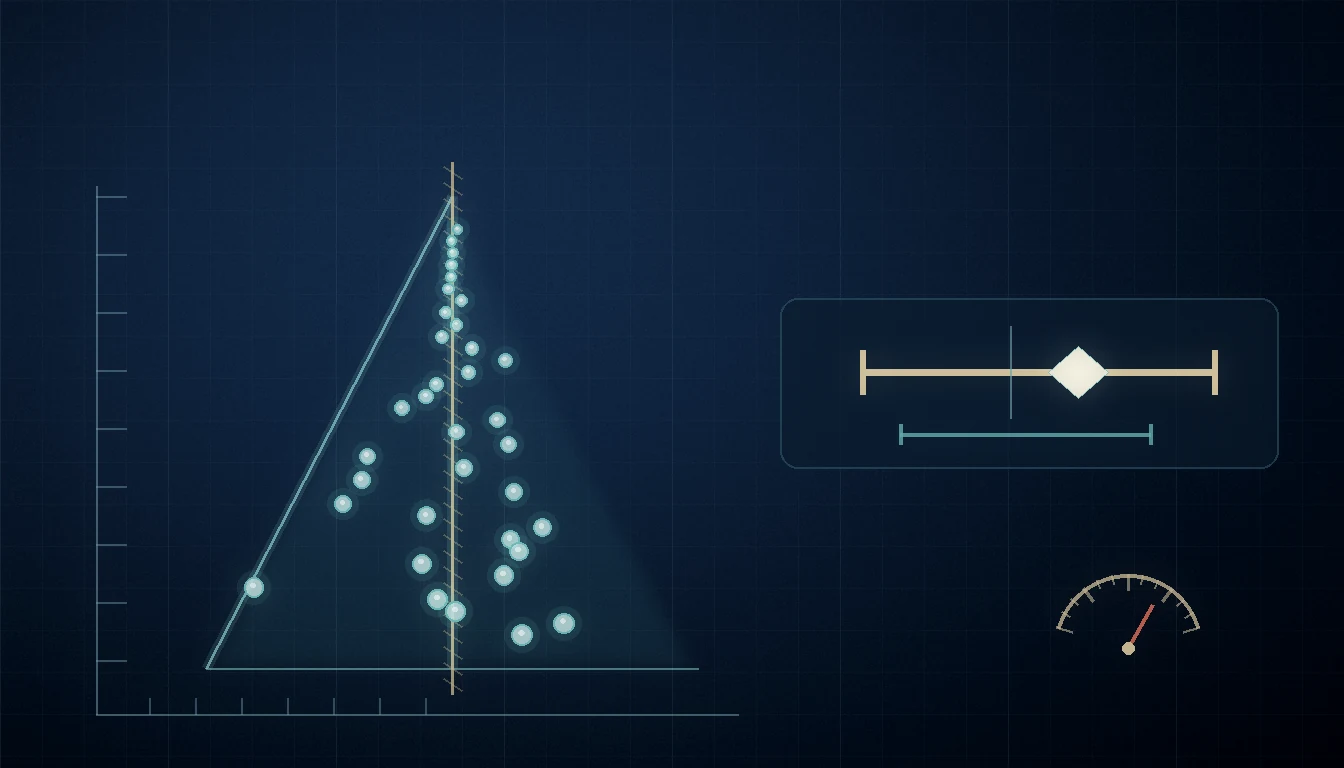
Thirty-five randomised trials. Three thousand and thirty-six patients. A pooled improvement of 2.90 points on the Montreal Cognitive Assessment. Those are the numbers at the top of a systematic review published in Frontiers in Neurology, and they will be in clinic brochures before the month is out.
Two other numbers in the same abstract deserve the same billing. An I² of 84%, which is the statistical signature of trials that disagree with each other far more than chance allows. And a sentence, buried mid-abstract, noting that every one of those 35 trials was conducted in China.
Neither fact makes the result false. Both of them change what a patient can reasonably do with it.
What the review actually pooled
The authors — Xiaosai Hu, Shurong Zhao, Dandan Zhang and Xianguo Meng, working out of Shandong First Medical University and the rehabilitation department of its affiliated Qianfoshan Hospital in Jinan — searched eight databases through mid-July 2026 and registered the protocol prospectively as CRD420261473579. They restricted inclusion to randomised controlled trials of adjunctive hyperbaric oxygen in patients with post-stroke cognitive impairment, with the MoCA as the primary outcome and the MMSE, NIHSS, Modified Barthel Index and Barthel Index as secondary measures.
The pooled effects are consistent in direction, and larger than most hyperbaric trials manage. MoCA rose by 2.90 points (95% CI 2.47–3.33). MMSE by 2.68 (2.20–3.16). The NIHSS, where lower is better, fell by 2.61 points (−3.34 to −1.89). Functional scores moved too: 6.64 points on the Modified Barthel Index and 8.77 on the Barthel Index.
Then come the caveats, and they are not decoration. Heterogeneity was severe on every outcome, reaching I² = 93% for the NIHSS. Prespecified subgroup analyses found no significant source of that heterogeneity for either cognitive scale (p = 0.10 and p = 0.43), which means the review could not explain it. Meta-regression suggested only that patients starting with higher MoCA scores gained less, and even that was borderline (β = −0.1411, p = 0.0637) and accounted for roughly 15% of the variance. GRADE certainty was rated low for MoCA, MMSE and the Modified Barthel Index, and very low for the NIHSS and Barthel Index. The authors’ own conclusion is a hedge: adjunctive HBOT may provide cognitive and functional benefits, the evidence base is exclusively Chinese, and generalisability is limited.
Two point nine points, measured against what
This is where hyperbaric reporting usually stops, and where the review’s own primary outcome deserves a closer look.
Cognitive scales are not thermometers. They have a noise floor, and in stroke populations that floor has been measured. A 2024 analysis by Erik Lindvall and colleagues at Gothenburg used 1,131 participants from the EFFECTS trial, a mean age of 71, and calculated both the minimal detectable change — the threshold above which a shift is probably real rather than test-retest wobble — and the minimal clinically important difference, anchored to the Stroke Impact Scale and EQ-5D.
The minimal detectable change for the MoCA after stroke was 5.1 points. The anchored MCIDs were 2 points and 1.6 points; the distribution-based MCID was 1 point.
Put the two studies side by side and the pooled effect lands in an awkward strip. At 2.90 points it clears the threshold patients describe as meaningful, and it sits comfortably below the threshold that tells a clinician the change is distinguishable from instrument variability in an individual. Neither number invalidates the other: a meta-analysis estimates an average across hundreds of patients, where measurement error shrinks, while the MDC governs one person in one clinic. But a clinic selling 20 sessions on the strength of “3 points on the MoCA” is quoting a population average as if it were a personal guarantee.
An earlier psychometric study in 65 stroke survivors on a rehabilitation ward found the MoCA’s responsiveness “moderate” (standardised response mean 0.67) and reported that between 31% and 51% of patients exceeded the MCID depending on the method — a useful reminder that a meaningful minority improve on standard rehabilitation alone.
A literature with one set of postcodes
The all-China composition of the evidence base is the review’s most consequential limitation, and it is worth being precise about why.
It is not that Chinese trials are uniquely suspect. It is that a pool with no trials from Europe, North America, Israel, Turkey, Egypt or Australia cannot tell you whether the effect survives different stroke aetiologies, different rehabilitation systems, different ICU practices, or different chambers. Hyperbaric capacity in China is large and often embedded inside rehabilitation departments, which shapes who gets treated and when; a patient treated on day 9 of an inpatient rehab admission is a different biological subject from an outpatient referred six months after discharge.
The network is also small. The review’s authors are in Shandong. So is the largest recent trial in the pool: a four-arm randomised study of 116 patients with post-stroke cognitive impairment from the hyperbaric department of Shandong Provincial Third Hospital, published this year in the Journal of Neuroengineering and Rehabilitation. That trial is genuinely informative — it compared hyperbaric oxygen alone, computerised cognitive training alone, the two combined, and standard treatment, over 20 sessions in four weeks, and found the combination outperformed the others on MMSE and the Barthel Index, with a parallel rise in resting-state functional connectivity between the left dorsolateral prefrontal cortex and Broca’s area on fNIRS (r = 0.552 with MMSE change). But a single-centre trial from the same province as the meta-analysis is not independent corroboration.
There is also a broader pattern in how this literature publishes. A 2025 bibliometric analysis of 323 hyperbaric-and-stroke papers from 2000 to 2022 found the United States dominant in volume and impact, with Tel Aviv University’s Sackler Faculty the most influential institution and Stroke the leading journal — and identified cognitive function as the field’s primary research focus. The recent randomised output, in other words, has migrated east while the citation base has not. And the pipeline is still filling: as recently as 2024 a Chinese group was publishing a protocol for a systematic review of hyperbaric oxygen in post-stroke insomnia, in a BMJ journal, listing nine databases including four Chinese ones — a sign of a research programme still at the stage of asking first questions.
The acute-stroke question is older and colder
Post-stroke cognition is the chronic end of a question the field has been asking since the 1990s, and the older answer is less flattering.
The 2014 Cochrane review by Michael Bennett and colleagues pooled 11 randomised trials and 705 participants treated for acute ischaemic stroke. Case fatality at six months did not differ: risk ratio 0.97 (0.34–2.75). Four of 14 disability and functional scales showed improvement — a mean 2.2-point reduction on the Trouillas Disability Scale, a 27.9-point gain on the Orgogozo Scale — but the reviewers concluded there was “no good evidence” that hyperbaric oxygen improves clinical outcomes in acute stroke, while conceding benefit had not been excluded. The theoretical worry is not exotic: hyperoxia raises arterial oxygen content and simultaneously lowers cerebral blood flow through vasoconstriction, and the net effect on a penumbra that is already marginal is precisely the thing the trials never settled.
A new cohort adds timing to that unresolved question without resolving it. Tang Xueqing and colleagues in the neurology department at Heyou Hospital in Foshan followed 429 patients who received hyperbaric oxygen within 72 hours of acute ischaemic stroke onset and stratified them by when treatment started. Against the 48-to-72-hour reference group, initiation under 24 hours carried an odds ratio of 2.68 (1.55–4.63) for a favourable 90-day modified Rankin score, and the 24-to-48-hour window 1.72 (1.04–2.82). Transcranial Doppler haemodynamic responses were more frequent in both earlier windows, and the authors built an exploratory “integrated early neurohaemodynamic response” phenotype that predicted outcome (OR 2.95, 1.76–4.92).
Read their own limitation paragraph before you read the odds ratios: single centre, retrospective, exposure-stratified, and with no non-hyperbaric comparator group at all. Earlier treatment may simply mark patients who were less sick, better insured, or admitted to a hospital that happened to have a chamber. The authors say as much — “the present findings do not establish HBOT efficacy relative to standard care without HBOT or a causal benefit of earlier initiation.”
What a chamber is allowed to be used for
Post-stroke cognitive impairment is not on any coverage list in the United States, and that has not changed.
Medicare’s national coverage determination 20.29 limits reimbursement to a fixed list: acute carbon monoxide intoxication, decompression illness, gas embolism, gas gangrene, acute traumatic peripheral ischemia, crush injuries and suturing of severed limbs, progressive necrotising infections, acute peripheral arterial insufficiency, preparation and preservation of compromised skin grafts, chronic refractory osteomyelitis, osteoradionecrosis and soft tissue radionecrosis as adjuncts to conventional treatment, cyanide poisoning, actinomycosis, and diabetic lower-extremity wounds meeting the Wagner grade III and failed-standard-therapy criteria. Stroke appears nowhere on it. Neither does cognitive impairment of any cause.
The Undersea and Hyperbaric Medical Society’s 15th-edition indications list — air or gas embolism, carbon monoxide poisoning, clostridial myositis, crush injury, decompression sickness, central retinal artery occlusion, problem wounds, severe anaemia, intracranial abscess, necrotising soft tissue infections, refractory osteomyelitis, delayed radiation injury, compromised grafts and flaps, acute thermal burn, idiopathic sudden sensorineural hearing loss and avascular necrosis — likewise contains no stroke entry. The device itself is a Class II product cleared through the 510(k) pathway under product code CBF; a clearance for the hardware is not a clearance for the diagnosis.
The FDA’s August 2025 letter to health care providers still applies to every session run under a research protocol or a wellness package: the agency reports fires in hyperbaric devices that caused serious injuries and deaths, states that the root cause is not known, and asks for instruction-for-use compliance, fire prevention, staff training, monitoring for the entire treatment, cleaning and maintenance at manufacturer-specified intervals, exclusion of prohibited electrical and static devices, and cotton rather than wool or synthetics against the skin.
None of this argues that the Chinese trials are wrong. It argues that the gap between a pooled 2.90 MoCA points and a reimbursed indication is currently bridged by nothing except a credit card. What would narrow it is unglamorous: trials outside China, sham or attention controls, blinded cognitive assessment, outcomes reported against the MDC rather than the raw scale, and enough follow-up to know whether three points at week four are still there at month twelve. Until then the honest summary of the post-stroke cognition literature is the one its own authors wrote — may provide benefit, low certainty, one country.
Sources
- Hu X, Zhao S, Zhang D, Meng X. Adjunctive hyperbaric oxygen therapy for post-stroke cognitive impairment: a systematic review and meta-analysis of randomized controlled trials. Front Neurol. 2026;17:1982226.
- Tang X, Song S, Wu S, Wang Y, Jin G, Ding C, Zeng Q. Hyperbaric oxygen therapy timing, early neurohemodynamic response and functional outcome in acute ischemic stroke. Exp Ther Med. 2026;32(6):339.
- Liu J, Han T, Yan C, Ma Q, Yuan L, Ge S, Xu X, Liu X. Hyperbaric oxygen therapy combined with computerized cognitive training improves global cognition and functional independence post-stroke: a randomized controlled trial. J Neuroeng Rehabil. 2026;23(1).
- Bennett MH, Weibel S, Wasiak J, Schnabel A, French C, Kranke P. Hyperbaric oxygen therapy for acute ischaemic stroke. Cochrane Database Syst Rev. 2014;(11):CD004954.
- Lindvall E, Abzhandadze T, Quinn TJ, Sunnerhagen KS, Lundström E. Is the difference real, is the difference relevant: the minimal detectable and clinically important changes in the Montreal Cognitive Assessment. Cereb Circ Cogn Behav. 2024;6:100222.
- Wu CY, Hung SJ, Lin KC, Chen KH, Chen P, Tsay PK. Responsiveness, minimal clinically important difference, and validity of the MoCA in stroke rehabilitation. Occup Ther Int. 2019;2019:2517658.
- Mijajlović MD, Pavlović A, Brainin M, Heiss WD, Quinn TJ, Ihle-Hansen HB, et al. Post-stroke dementia - a comprehensive review. BMC Med. 2017;15(1):11.
- Huang Y, Chen S, Leng X, Kuo K, Wang Z, Cui M, Tan L, Wang K, et al. Post-stroke cognitive impairment: epidemiology, risk factors, and management. J Alzheimers Dis. 2022;86(3):983-999.
- Filler J, Georgakis MK, Dichgans M. Risk factors for cognitive impairment and dementia after stroke: a systematic review and meta-analysis. Lancet Healthy Longev. 2024;5(1):e31-e44.
- Zhou M, Chen X, Li D, Luo J, Song S, You J, Ma H, Huang C. Bibliometric analysis of research trends on hyperbaric oxygen therapy in stroke from 2000 to 2022. Front Neurol. 2025;16:1455545.
- Calvert JW, Cahill J, Zhang JH. Hyperbaric oxygen and cerebral physiology. Neurol Res. 2007;29(2):132-141.
- Zhang H, Zhou C, Sun F. Effects of hyperbaric oxygen therapy on cerebral activity in stroke patients based on fNIRS. Sensors (Basel). 2026;26(6):1794.
- Shi R, Meng W, Liu Z, Chang L, Lu R, Chen X, Xue W, Deng Y. Hyperbaric oxygen therapy for poststroke insomnia: a systematic review and meta-analysis protocol. BMJ Open. 2024;14(3):e081642.
- US Food and Drug Administration. Follow Instructions for Safe Use of Hyperbaric Oxygen Therapy Devices - Letter to Health Care Providers. Content current as of 25 August 2025.
- Centers for Medicare & Medicaid Services. National Coverage Determination 20.29: Hyperbaric Oxygen Therapy.
- Undersea and Hyperbaric Medical Society. Hyperbaric Oxygen Therapy Indications, 15th edition.