
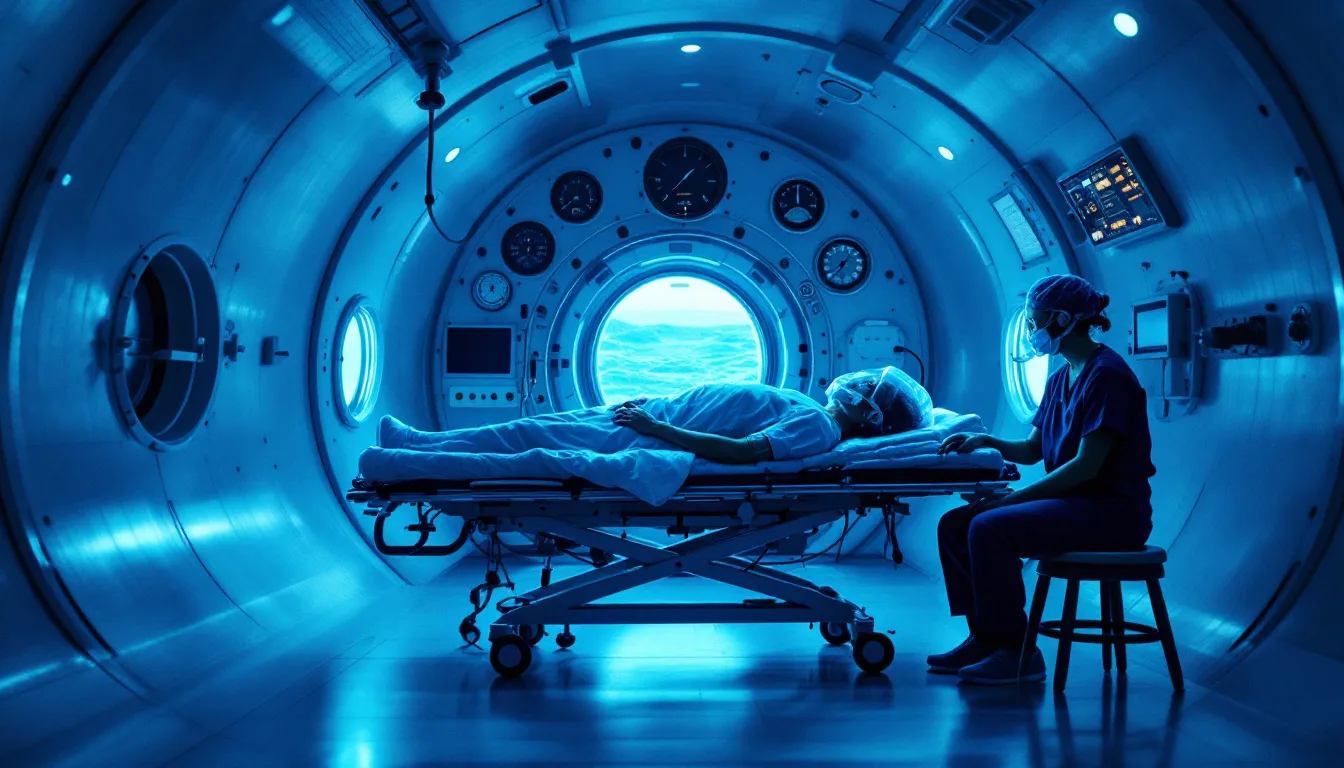
A monoplace chamber is a lonely place: one patient, sealed in a clear tube, watched from outside. A multiplace chamber is not. It is a walk-in steel room, and in most treatment centres somebody stays in it for the whole session — a nurse, a technician, usually the person who would unclip the mask if something went wrong. The job title is inside attendant. It comes with a hazard that almost nobody outside hyperbaric medicine has heard of.
Inside a multiplace chamber, the two people in the room are breathing very different things. The patient breathes oxygen through a hood or mask, at partial pressures that can reach the equivalent of 2.8 atmospheres, which is the whole point of the therapy: flood the tissues, drive healing, shrink gas bubbles. The attendant breathes ordinary compressed chamber air. So while the patient is washing nitrogen out of the body, the attendant is loading it in. Both of them have to come back to surface pressure safely, and only one of them is on an oxygen schedule.
That asymmetry is the subject of a paper published on 30 September in Diving and Hyperbaric Medicine, and it arrives with a proposal the authors describe as new to the field.
Same room, different gas loads
Attendants are not left unprotected. The standard decompression schedule they follow is derived from the US Navy Treatment Table 6, the same table used to treat the divers and patients in the chamber, and its Swedish Armed Forces equivalent. Those schedules give the inside attendant periods of oxygen breathing before and during decompression, which is how the nitrogen load is cleared.
The problem the Swedish group identifies is timing. The attendant’s oxygen periods are concentrated in the later part of the treatment. That arrangement is fine for an orderly, planned ascent at the end of a four-and-a-half-hour table. It is much less fine if the chamber has to come up early — a patient who deteriorates, a medical emergency, smoke, a failed piece of equipment. In that scenario, the person who has spent most of the session breathing air at pressure has had no chance to wash out nitrogen, and a rapid ascent is exactly the condition that produces decompression sickness.
What the Swedish team actually changed
Mårten Silvanius and colleagues, working across the Blekinge Institute of Technology, the Swedish Armed Forces Diving and Naval Medicine Centre in Karlskrona and Lund University, rescheduled the attendant’s oxygen periods to an earlier stage of the session. Then they tested the idea computationally, using the exponential linear Thalmann decompression algorithm with SWEN21B parameters to model compartmental gas loading and compare the original regimen with the reshuffled one.
Their conclusion is modest but specific: the alternative regimen stays within the permissible limits of the decompression algorithm while allowing emergency decompression to be carried out across a longer stretch of the treatment. In other words, more of the session becomes escapable without moving the attendant into an unsafe tissue-gas state.
Read that for what it is. This is a modelling study — no patients, no attendants, no measured bubble loads. It tests a schedule against a decompression algorithm, not against human outcomes, and the algorithm’s parameters are the authors’ own assumptions. The paper is also embargoed for twelve months at the journal, so only the abstract is publicly available. A sensible unit might use it to reconsider how it schedules attendant oxygen; it is not a licence to start cutting the standard tables short.
How often does this actually go wrong?
Two facts sit uncomfortably next to each other in the literature. The first is that modern attendant protocols look extraordinarily safe when you count exposures. A 28-year review from the hyperbaric centre at the University of California San Diego reported zero cases of decompression sickness and zero episodes of central nervous system oxygen toxicity among attendants, across more than 24,000 chamber exposures, using three escalating oxygen protocols.
The second fact is that the counting unit matters. As a 2017 review in Undersea and Hyperbaric Medicine put it, incidence expressed as cases per exposure is low, but cumulative worker risk — the chance that any given attendant eventually gets hit — is not the same number, and it is not negligible. The same review notes that attendant decompression sickness usually responds well to recompression and rest, but that permanent and career-ending injuries do occur, and that at least two nurses are reported to have died from their decompression injuries.
The case reports explain why the risk never quite disappears. In 2021, clinicians at the Polish hyperbaric centre in Gdynia described a 51-year-old hyperbaric physician — an experienced diver — who worked as inside attendant through an ordinary session of 70 minutes at 2.5 atmospheres absolute. Ten minutes after the chamber was back at surface pressure he had symptoms of spinal cord decompression sickness. He was recompressed within 90 minutes, recovered fully on a US Navy Treatment Table 6, and returned to hyperbaric work four weeks later. Transoesophageal echocardiography 18 months on found no persistent foramen ovale. The exposure itself had been routine.
A 2024 report in the same journal described the opposite mechanism: a nurse who developed cutaneous decompression sickness twice while attending patients, and who turned out to have an 11-millimetre persistent foramen ovale — a right-to-left shunt that lets venous gas bubbles bypass the lungs. She had the defect closed and returned to work without recurrence. Age, dehydration, fatigue, an awkward posture held for hours and a large cardiac shunt are all part of the risk picture, and the UHMS has published medical fitness-to-work guidelines for multiplace inside attendants to address exactly that.
The equipment in the room has not been cleared either
The same September issue of Diving and Hyperbaric Medicine carries a second paper on what else the chamber does to the people and devices inside it. A Melbourne-based team ran a bench study on an external ventricular drain — the catheter used in neurocritical care to measure intracranial pressure and drain cerebrospinal fluid — exposing a commercially available Codman EDS 3 system to stepped ambient pressures from 101 to 283 kPa inside a multiplace chamber.
The hardware survived intact. The measurements did not entirely behave. Pressure readings were stable in a rigid, open, non-compliant model, but in closed compliance-based models the same measurements varied during pressurisation, including when the system was closed to drainage, and unclamped drainage behaviour could not be assessed reliably at all. The authors’ conclusion is a warning rather than a result: intracranial pressure readings taken during hyperbaric treatment should be interpreted with caution, because pressure-related artefacts are plausible and have not been characterised. For any unit that treats ventilated neurosurgical patients — a caseload that has been growing in some European centres — that is an unresolved monitoring problem.
What the FDA letter does and does not cover
None of this touches the status of hyperbaric oxygen therapy as a regulated medical treatment. HBOT devices are Class II devices cleared through the 510(k) pathway under Product Code CBF, and the cleared indications remain a specific list: decompression sickness, carbon monoxide poisoning, certain non-healing diabetic wounds, late radiation tissue injury, gas gangrene, severe anaemia, selected skin grafts and flaps, crush injury, thermal burns, idiopathic sudden sensorineural hearing loss and intracranial abscess. Attendant safety protocols, recompression modelling and ventilator compatibility are clinical practice questions inside those indications; they do not create new ones.
The FDA’s August 2025 letter to health care providers is the other anchor. The agency said it was aware of reports of serious injuries and deaths with HBOT devices — including fires whose root cause was still unknown — and told facilities to follow manufacturers’ instructions, maintain fire prevention measures, train and retain staff, monitor the patient throughout, keep to cleaning and maintenance intervals, and control which items and materials go inside the chamber. An inside attendant is both the person responsible for much of that control and the person standing closest to whatever goes wrong. That is the argument for taking a paper about oxygen timing seriously, even when the evidence behind it is a computer model.
Hyperbaric units are already among the most heavily regulated spaces in a hospital, and every session they run puts a staff member under pressure by design. The question the Swedish schedule poses is narrower than it first appears, and more practical: if the chamber has to come up early, how many minutes of that treatment can the person inside still survive without getting bent?
The algorithm says more than the current schedule allows. Somebody now needs to test that in a chamber.
Sources
- Silvanius M, Plogmark O, Forsberg M, Frånberg O. Early nitrogen wash-out for inside attendants during hyperbaric oxygen therapy: a novel oxygen distribution regimen. Diving and Hyperbaric Medicine. 2026;56(3):286-293. doi:10.28920/dhm56.3.286-293
- Ramchandani R, Lin ZC, Devaney B, Jeffree RL, Tsouras T. Evaluation of external ventricular drain performance under hyperbaric conditions: a bench study. Diving and Hyperbaric Medicine. 2026;56(3):323-328. doi:10.28920/dhm56.3.323-328
- Kot J, Lenkiewicz E, Lizak E, Góralczyk P, Chreptowicz U. Spinal cord decompression sickness in an inside attendant after a standard hyperbaric oxygen treatment session. Diving and Hyperbaric Medicine. 2021;51(1):103-106. doi:10.28920/dhm51.1.103-106
- Clarke R. Health care worker decompression sickness: incidence, risk and mitigation. Undersea and Hyperbaric Medicine. 2017;44(6):509-519
- Witucki P, Duchnick J, Neuman T, Grover I. Incidence of DCS and oxygen toxicity in chamber attendants: a 28-year experience. Undersea and Hyperbaric Medicine. 2013;40(4):345-350
- Wilmshurst PL, Edge CJ. Recurrent cutaneous decompression sickness in a hyperbaric chamber attendant with a large persistent foramen ovale. Diving and Hyperbaric Medicine. 2024;54(4):354-359. doi:10.28920/dhm54.4.354-359
- FDA — Follow Instructions for Safe Use of Hyperbaric Oxygen Therapy Devices: Letter to Health Care Providers (August 25, 2025)