
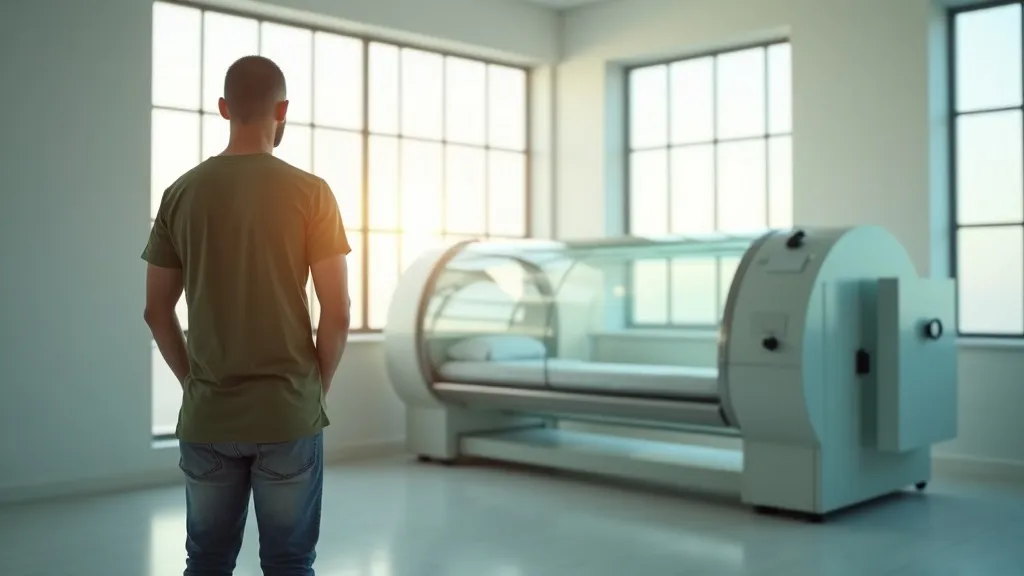
Few groups have been targeted by hyperbaric oxygen marketing as persistently as veterans. Clinics promote the therapy as a treatment for traumatic brain injury (TBI) and post-traumatic stress disorder (PTSD), and Congress has repeatedly pressed the Department of Defense and Veterans Affairs to make it more widely available. Yet when you read what U.S. government bodies have actually published, the picture that emerges is markedly more sober than the advertising suggests.
The largest federal trials found no benefit over sham
The most rigorous test of HBOT for service members came from the Department of Defense itself. The HOPPS randomized clinical trial, published in JAMA Internal Medicine in 2015, enrolled 72 active-duty service members with persistent post-concussion symptoms and compared hyperbaric oxygen against sham chamber sessions. Its conclusion was blunt: HBOT “showed no benefits over sham compressions,” and the results “do not support” advancing to phase 3 trials.
That finding did not stand alone. The VA’s Health Services Research & Development Evidence Synthesis Program reviewed the literature and concluded that, for chronic mild TBI, hyperbaric oxygen does not produce short-term improvement in post-concussion or PTSD symptoms compared with sham — and that the sparse long-term data give no reason to believe any apparent improvement is durable.
What the GAO oversight review found
In December 2015, the Government Accountability Office published its own assessment, Defense Health Care: Research on Hyperbaric Oxygen Therapy to Treat Traumatic Brain Injury and Post-Traumatic Stress Disorder (GAO-16-154). The GAO examined 32 peer-reviewed articles published between 2005 and 2015 and found the evidence for mild TBI to be mixed and methodologically limited.
One of the recurring scientific debates the GAO highlighted is worth understanding: in the negative DoD trials, even the “sham” group sometimes improved. Proponents argue this means the sham wasn’t truly inert and may have masked a real effect; skeptics argue it points to a placebo response and natural recovery. That unresolved question is precisely why federal reviewers have been unwilling to declare HBOT effective for these conditions.
The official clinical guidance
The practical upshot is reflected in clinical policy. The VA/DoD clinical practice guidance on post-acute mild TBI does not endorse hyperbaric oxygen for symptoms attributed to mild TBI, consistent with the trial evidence above. And critically, HBOT is not FDA-cleared for either TBI or PTSD — any use for these conditions is off-label.
The proponent counter-argument
It would be incomplete to ignore the other side. A 2024 systematic review in Frontiers in Neurology argued, based on a dosage analysis, that HBOT should be considered a treatment option for PTSD. But this represents a minority position advanced in part by long-time HBOT advocates, and it has not shifted the federal consensus built on the sham-controlled trials.
The bottom line for veterans
Hyperbaric oxygen is a legitimate, well-supported therapy for its FDA-cleared indications. TBI and PTSD are not among them. Veterans considering paying out of pocket for HBOT marketed as a proven cure for brain injury or PTSD should weigh that the best government-funded evidence found no benefit over placebo, that the therapy carries real risks such as barotrauma and oxygen toxicity, and that VA and DoD clinicians can advise on treatments with stronger evidence behind them.
Sources
- GAO — Defense Health Care: Research on HBOT to Treat TBI and PTSD (GAO-16-154)
- JAMA Internal Medicine — HBOT for Persistent Postconcussion Symptoms (HOPPS randomized trial)
- VA HSR&D — Evidence Brief: Hyperbaric Oxygen Therapy for TBI and/or PTSD
- Frontiers in Neurology (2024) — Systematic review: HBOT efficacy in PTSD (proponent view)