
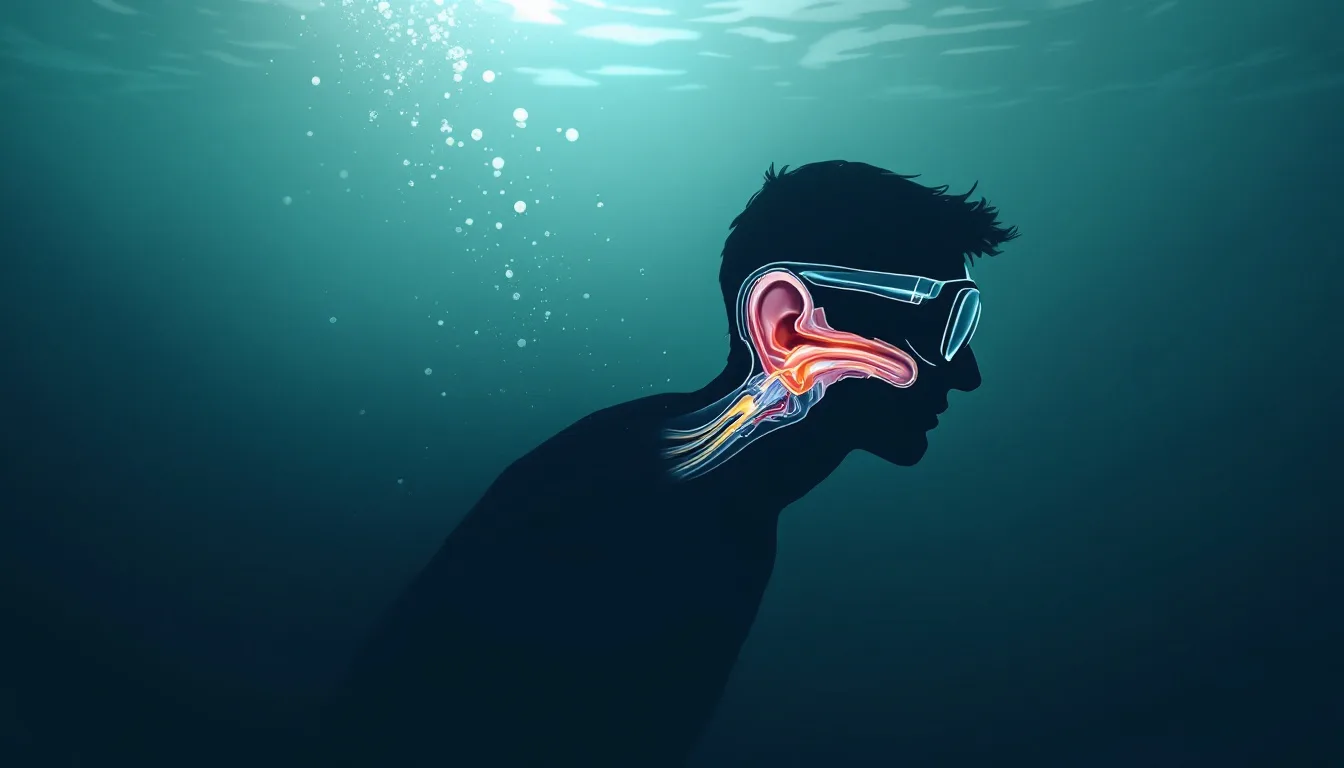
A diver surfaces from a routine 30-metre dive with a spinning room, a muffled ear and a sensation of fullness on one side. The dive computer logged a clean profile. The ascent was slow. There was no rash, no joint pain, no weakness in the legs — none of the textbook signs that normally send a diver to a hyperbaric chamber.
The clinician now faces a question that decides everything. Is this inner-ear barotrauma, a mechanical squeeze injury to the delicate structures of the inner ear? Or is it inner-ear decompression sickness, a bubble-mediated injury that belongs in a recompression chamber as soon as it can be arranged? At the surface the two can look almost identical, and the correct answer points in nearly opposite directions.
That fork in the road — and the wider question of what actually brings divers to hospital — is the subject of a cluster of papers published in the third quarter of 2026. The picture they draw is considerably broader than “the bends”.
What Reaches the Emergency Department
The largest of the new studies comes from the Mayo Clinic. Dr Andy Tom and colleagues at the Mayo Clinic Alix School of Medicine analysed two decades of scuba-related injuries recorded in the National Electronic Injury Surveillance System, the nationally weighted sample of United States emergency-department visits, covering 2005 to 2024. They separated paediatric presentations from adult ones.
The paediatric cohort was small — 68 cases, which the system’s weighting translates into roughly 122 paediatric scuba-related emergency-department visits a year — and the authors are explicit that these figures describe presentation patterns rather than the overall injury risk facing young divers. Even so, the distribution is instructive. Trauma was the single largest category at 41.2 percent, followed by otitis at 17.6 percent and ear, sinus, ocular or dental barotrauma at 16.2 percent. Possible decompression sickness or arterial gas embolism accounted for about one presentation in ten.
Where the injury category changed, so did the consequences. Admission was most common among patients with possible decompression sickness or arterial gas embolism, at 42.9 percent, and among those with drowning or aspiration, at 25.0 percent. Compared with adults, younger patients were less likely to be hospitalised (10.3 percent versus 21.4 percent, p = 0.038), more likely to arrive with traumatic injury (41.2 percent versus 26.1 percent, p = 0.010) and less likely to be suspected of having decompression sickness or gas embolism (10.3 percent versus 25.0 percent, p = 0.006).
The Ear, Read by Phase of Dive
If trauma dominates the raw counts, the ear is where diving medicine becomes difficult. A structured review by Dr Anna Onderkova at Royal Brompton Hospital, part of Guy’s and St Thomas’ NHS Foundation Trust in London, screened PubMed, Embase and the Cochrane Library and retained 40 analytic studies — large cross-sectional surveys plus multiple case series of inner-ear decompression sickness — then reorganised the evidence by phase of dive: descent, bottom time, ascent.
Middle-ear barotrauma emerged as the most prevalent diving-related ear, nose and throat injury, and it happens overwhelmingly on descent, when a diver who cannot equalise the pressure differential across the eardrum pays for it. Inner-ear barotrauma and inner-ear decompression sickness were considerably less common, but carried what the review calls a substantially higher risk of persistent auditory or vestibular deficit. The list continues past the ear itself: sinus barotrauma, otitis externa and the bony external canal exostoses familiar to cold-water divers, temporomandibular joint symptoms, dental barotrauma, and injuries from marine exposure.
The review is also candid about what the literature cannot settle. Evidence on divers who have had ear surgery — stapedectomy, tympanoplasty, mastoidectomy, cochlear implantation — is described as limited, heterogeneous and often contradictory, with few data to guide a return-to-dive decision. Onderkova’s conclusion is that a phase-aware framework gives clinicians a way to contextualise when symptoms began, and that prospective studies are needed before screening and clearance practices can be put on firmer ground.
The phase of dive matters because it is often the only discriminator available at the surface. Barotrauma of the inner ear follows a pressure insult, typically on the way down, and is managed by removing the diver from further pressure exposure while the injured tissue settles. Inner-ear decompression sickness follows inert-gas loading, typically on or after the ascent, and is a recompression problem. Emergency and diving-medicine guidance turns on exactly that distinction, which is why a case that looks like one can be the other.
Teeth, Fillings and the Dentist Nobody Told
Dental barotrauma is the least discussed member of the family, and a new survey from Senegal suggests it is more common than its profile implies. Dr Adjaratou Wakha Aidara and colleagues at Cheikh Anta Diop University in Dakar ran a STROBE-compliant cross-sectional study across the three organised civilian diving clubs in the city between March and October 2023, distributing a questionnaire in French to 360 registered divers and receiving 160 responses. Outcomes were self-reported and no clinical examination was performed; pain reported only at constant depth was excluded from the primary case definition.
Twenty-four respondents reported dental barotrauma, a prevalence of 15.0 percent (95 percent CI 10.3–21.3), and 21 reported pressure-related dental pain consistent with barodontalgia, 13.1 percent (95 percent CI 8.7–19.2) — rising to 16.2 percent once the phase restriction was lifted. Thirty-six divers, or 22.5 percent, reported at least one such event, most at 20 metres or shallower. Posterior teeth, maxillary teeth and previously restored teeth were each frequently named, and barotrauma showed crude associations with longer diving experience, older age and more than 60 lifetime dives.
The finding that should travel furthest is a counselling gap. Only about half of the affected divers had told their dentist that they dive, and fewer than one in five had received any diving-specific advice. The authors label the work hypothesis-generating precisely because the outcomes are self-reported and clinically unverified — but the direction of the signal is hard to ignore.
When the Answer Is Neither
Not every diver who deteriorates after a dive has a pressure injury at all, a point underlined by a case report from Dr R. A. van Hulst in the same issue of Diving and Hyperbaric Medicine. A diver presented to hospital after three consecutive days of diving with chest pain, shortness of breath, nausea and sensory abnormalities across his body, arms and legs. The presentation could have suggested cardiac involvement, or decompression sickness. The actual cause was ciguatera intoxication after eating fish. The report sets out the overlapping pathology of the two conditions and the differential diagnosis that separates them — a reminder that exposure history includes what a diver ate, not only where a diver went.
The Same Injury, From the Other Side of the Door
There is an irony here that hyperbaric units know well. Middle-ear barotrauma is also the most common complication of hyperbaric oxygen therapy itself, affecting roughly 5 to 10 percent of patients treated, according to the 2026 review of hyperbaric side effects by Dr Marvin Heyboer and William Santiago in the Undersea and Hyperbaric Medicine Journal. The physics that injures a diver’s ear on descent is the same physics that acts on a patient who cannot equalise inside a chamber, and the countermeasures are the same: screening before treatment, coaching on equalisation, and nasal decongestants or a temporary tympanostomy tube where the Eustachian tube will not cooperate.
Where Hyperbaric Oxygen Fits — and Where It Does Not
None of this new work changes what hyperbaric oxygen is actually cleared to do. Decompression sickness and arterial gas embolism remain the original and best-established indications: the FDA clears hyperbaric devices as Class II devices through the 510(k) pathway under Product Code CBF, the Undersea and Hyperbaric Medical Society lists both conditions among its approved indications, and Medicare covers them under national coverage determination 20.29. For the diver in the opening scenario, the possibility of inner-ear decompression sickness is the reason to involve a hyperbaric unit early rather than wait.
What the cluster does not do is extend hyperbaric oxygen to trauma, otitis, sinus barotrauma or dental barotrauma, where no chamber role is established. Nothing here concerns the wellness, longevity, athletic-recovery or anti-ageing uses that dominate the consumer market, and the FDA’s position on those is unchanged. The agency’s letter to health care providers, current as of August 25, 2025, reminds facilities that hyperbaric devices are cleared for specific indications, that it has received reports of serious injuries and deaths from fires associated with the devices, and that providers must follow manufacturer instructions — including restrictions on electrical and static-generating items inside the chamber.
The three studies converge on a practical point rather than a therapeutic one. Diving injury is mostly not decompression sickness: it is trauma, ear disease and a set of pressure problems that are preventable, under-reported and, in the dental case, barely discussed with the clinicians best placed to spot them. Because all three are retrospective or self-reported — a weighted surveillance sample, a heterogeneous review, a questionnaire — their authors present them as a starting point, and it is where the next round of prospective work should look.
This article reports published research and regulatory guidance. It is not medical advice; anyone experiencing hearing loss, vertigo or pain after a dive should be assessed by a qualified clinician.
Sources
- Tom A, Lindberg S, Navarro S, Stephens D, et al. Scuba-related injuries presenting to United States emergency departments: paediatric and adult patterns. Diving Hyperb Med. 2026;56(3):303-308.
- Onderkova A. Diving-related ear, nose, and throat disorders: a structured review using a phase-of-dive framework. Diving Hyperb Med. 2026;56(3):329-341.
- Aidara AW, Kassir S, Leye-Benoist F. Dental Barotrauma and Pressure-Related Dental Pain Among Civilian Scuba Divers in Dakar, Senegal: A Cross-Sectional Study. Clin Exp Dent Res. 2026;12(5):e70451.
- van Hulst RA. Decompression sickness or ciguatera intoxication: a case report. Diving Hyperb Med. 2026;56(3):381-383.
- Heyboer M, Santiago W. Side Effects of Hyperbaric Oxygen Therapy. Undersea Hyperb Med. 2026.
- FDA — Follow Instructions for Safe Use of Hyperbaric Oxygen Therapy Devices: Letter to Health Care Providers (August 25, 2025)
- Undersea and Hyperbaric Medical Society — HBO Indications (15th edition list)